Chongqing Travel Guide & Tours
After organizing travel experiences in Chongqing for many years, we've learned that this is a city best understood through its scenery, but never through scenery alone. The rivers, hills, and night views create strong visual impressions, yet what makes Chongqing memorable is how these landscapes are woven directly into daily urban life.
When we plan and organize journeys here, we balance iconic sights with neighborhood rhythms, helping travelers see not just where to go, but why it matters. Below is how we approach the city's many layers.
City Between Rivers
Chongqing sits precisely where the Yangtze and Jialing rivers converge, a geographic fact that shaped its destiny as a strategic port since the Song dynasty. Today, that confluence is most vivid at Chaotianmen Square, once a bustling customs checkpoint and now flanked by the futuristic Raffles City towers. From its elevated plaza, you can watch container ships navigate the wide Yangtze while commuter ferries dart across the narrower Jialing.
We often organize early-morning walks along Dongshuimen Bridge, where fishermen cast lines into swirling currents and retirees practice calligraphy with water brushes on stone tiles. A short ferry ride from Chaotianmen to Jiangbeizui costs less than one yuan and offers an unfiltered view of Hongya Cave's stilted architecture rising from the cliffside, far more authentic than any postcard.
The rivers aren't decorative; they're functional. Even today, sand barges and coal carriers ply these waters, and riverside neighborhoods like Nanbin Road and Tushan remain deeply connected to seasonal floods, fog patterns, and river trade cycles.
Mountains And Urban Views
Chongqing is built on steep folds of the Sichuan Basin, forcing architecture and infrastructure into vertical solutions. Nowhere is this clearer than at Liziba Station, where Metro Line 2 famously passes through the ninth floor of a residential building, a sight we never skip, but we also linger afterward in the surrounding alleys to observe how residents hang laundry over rail tracks or chat from balconies just meters from speeding trains.
For panoramic immersion, we organize visits to Eling Park, one of the city's oldest green spaces. Its pagoda overlooks the Jialing River winding through dense neighborhoods, with rooftops stacked like terraced rice fields. On clear days, you can spot the twin peaks of Geleshan, a forested ridge west of the city that once housed wartime intelligence offices.
Further afield, Nan Shan (Southern Mountain) offers both natural respite and commanding views. We time hikes to coincide with late afternoon light, when the entire Yuzhong Peninsula glows amber beneath a lattice of bridges, including the majestic Shibanpo Yangtze River Bridge.

Riverfront Scenic Areas
While many cities treat waterfronts as leisure zones, Chongqing's riverbanks remain lived-in. Nanbin Road exemplifies this: a 3-kilometer promenade lined with art deco-style streetlights, open-air mahjong tables, and impromptu dance circles. Locals gather here after work to watch cruise boats glide toward the Three Gorges.
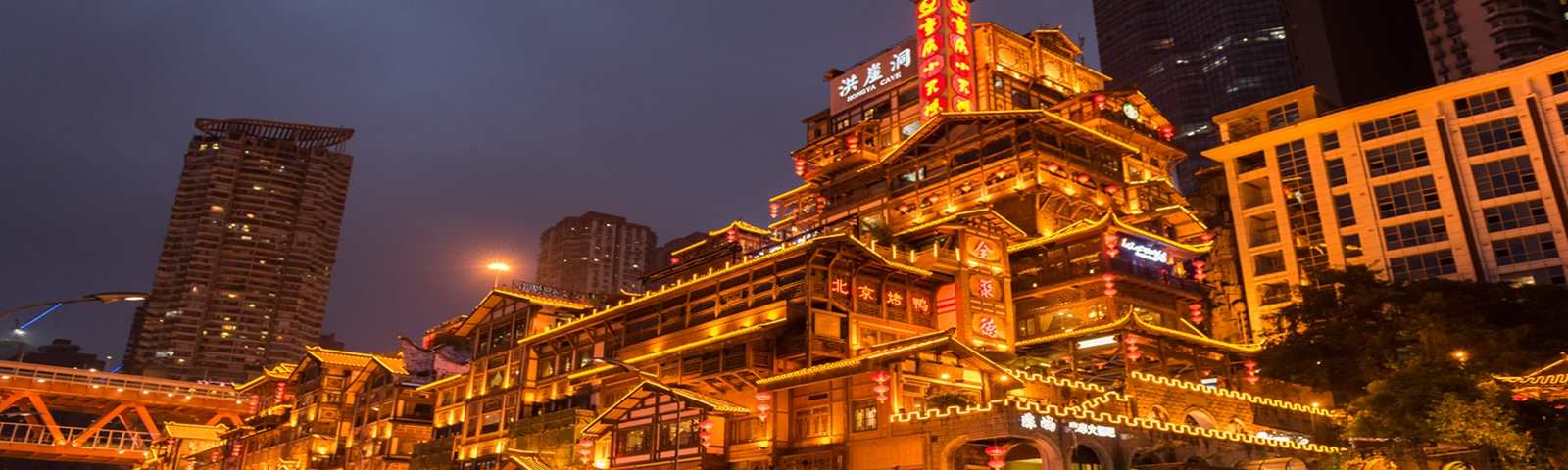
We often organize evening strolls here, pausing at viewpoints opposite Hongya Cave, a 11-story stilted complex inspired by traditional diaojiaolou. Though commercialized, its structure is genuine: built into a cliff face above the Jialing, it channels foot traffic vertically via escalators and skywalks.
Upstream, Jiangbeizui Central Park blends finance and foliage. Once marshland, it's now a green lung amid skyscrapers, featuring sculptures honoring Chongqing's role as China's wartime capital (1937--1946).
Historic City Landscapes
Beyond postcard alleys, Chongqing's history lives in layered textures. Ciqikou Ancient Town, though popular, still retains authenticity if you venture past the main drag. Behind souvenir stalls selling mala taffy lie narrow lanes like Zhongshuge Alley, where ancestral halls and courtyard homes shelter tea masters brewing aged pu'er in clay pots.

We also organize visits to Huguang Guild Hall, a Qing-era complex built by migrants from Hubei and Hunan. Its opera stage, carved beams, and ancestral tablets reveal how merchant networks sustained the city long before modern industry.
Less known but equally compelling is St. Joseph's Cathedral in Shapingba, a Gothic Revival church built by French missionaries in 1893. Surrounded by university students and noodle shops, it stands as a quiet testament to Chongqing's cosmopolitan past.
And for wartime memory, we include Hongyan Village, once headquarters of the Communist Party's southern bureau. Its modest villas and bomb shelters tell stories of resilience during Japanese air raids.
Nighttime City Scenes
Chongqing doesn't dim at night, it multiplies. From Nanshan One Tree Viewpoint, the city appears as a luminous tapestry: highways snake like glowing veins, apartment blocks blink in staggered rhythms, and riverboats leave phosphorescent trails.
But we also value intimacy. In Eling, we might organize rooftop seating at a family-run xiaochi stall, where you eat cold noodles under string lights while listening to distant metro horns. Or in Jiefangbei, Chongqing's commercial heart, we suggest wandering after midnight when neon signs flicker over empty plazas.
Cruise options exist, but we rarely recommend generic dinner boats. Instead, we sometimes organize private sampan rides near Caiyuanba, where local boatmen share stories of river life while navigating quieter tributaries under moonlight.
Daily Life Views
Chongqing's charm hides in routine. In Banan District, dawn markets buzz with farmers selling wild mushrooms, mountain yams, and pickled vegetables from bamboo baskets. Near Lianglukou, public "hillside elevators" shuttle residents between upper and lower streets, free, efficient, and utterly ordinary.
We build unscripted moments into our itineraries: watching a tailor mend clothes on a sidewalk sewing machine in Shangqingsi, or seeing schoolchildren descend 200 steps from a hilltop campus to catch the bus. In Niujiatuo, old men play xiangqi under banyan trees while neighbors debate stock prices over bowls of congee.
These scenes aren't staged, they're the city breathing. And because Chongqing's terrain demands physical engagement (stairs, slopes, lifts), daily life here feels unusually tactile.
Food And City Rhythm
Chongqing cuisine is bold, but not reckless. Yes, hotpot dominates, but true locals seek balance. We organize meals at institutions like Zeng Laoyao Hotpot in Nan'an, where broth simmers with doubanjiang, dried chilies, and Sichuan peppercorns toasted daily. Diners dip duck blood, lotus root, and hand-cut tripe, not for heat, but for communal ritual.
Beyond spice, there's subtlety. Xiaomian (small noodles) vary by neighborhood: in Guanyinqiao, slick with chili oil and preserved vegetables; in Ciqikou, served with braised beef and bone broth. We visit family-run stalls where the same recipe has simmered for three generations.
Street snacks reveal climate adaptation: liangfen (chilled mung bean noodles) cool summer heat; guokui (stuffed flatbreads) warm winter evenings. Late-night favorites include suantang feichang (sour soup with pig intestines), a hangover cure and comfort food rolled into one.
We also highlight non-spicy gems: steamed chaoshou (wontons) in clear chicken broth, sweet sesame balls from temple-side vendors, and osmanthus rice wine served chilled in porcelain cups. Meals here follow circadian logic: light breakfasts, hearty lunches, social dinners, and midnight snacks.
When arranging dining, we prioritize places where staff greet regulars by name and where the kitchen closes when ingredients run out.
Getting Around Easily
Navigating Chongqing requires embracing its three-dimensional logic, but it's far easier than it looks. As locals say: "If you can read a map, you'll get lost. If you follow your feet, you'll find the city."
We always begin by explaining the metro system, one of China's most scenic and efficient. Lines 1, 2, 3, and 6 cover most tourist zones, and all stations display English signage. Line 2 is especially useful: it connects Jiaochangkou (near Jiefangbei) to Liziba, Yangjiaping, and Ciqikou, making it ideal for half-day explorations. Fares range from ¥2–
6; payment via Alipay/WeChat is seamless.
For river crossings, public ferries remain the cheapest and most atmospheric option. The Chaotianmen-Jiangbeizui route (¥1.8) runs every 15 minutes and offers unmatched skyline views. We often organize these as transitional moments between districts, not just transport, but experience.
Taxis are plentiful and affordable (starting at ¥10), but traffic congestion in Yuzhong can be severe. We advise using them for evening returns or when carrying luggage. Ride-hailing apps like DiDi work well, though drivers may struggle with English addresses, so we provide Chinese-character destination cards to all travelers.
Walking is essential but wear sturdy shoes. Many "flat" routes involve hidden staircases or sudden elevation changes. Apps like Baidu Maps (more accurate than Google here) show elevation profiles and real-time pedestrian paths. We pre-plan walking segments with rest points: teahouses, park benches, or street snack stops.
Finally, don't overlook public elevators and escalators. The Kaiyuan Elevator near Eling, the Fuling Stairway Escalator, and the Lianglukou Hillside Lift are free civic infrastructures that locals use daily. We incorporate them into routes not as novelties, but as practical, and poetic, ways to move with the city.
Our Tour Philosophy
As China Expedition Tours' team, we've organized journeys across western China for over a decade. In Chongqing, we resist simplification. This isn't just a "mountain city" or "hotpot capital", it's a place where geography dictates rhythm, history hides in alleyways, and beauty emerges in transit.
We don't chase checklists. Instead, we plan routes that move with the city: riding ferries, climbing staircases, sharing meals on plastic stools, and listening to stories told in thick Chongqing dialect. Our itineraries include buffer time for fog delays, spontaneous conversations, or simply sitting on a riverbank bench as dusk falls.
Our goal isn't to show you Chongqing. It's to help you feel its pulse: layered, resilient, humid, loud, and vividly alive. When travelers leave, we hope they carry not just photos, but the memory of how it felt to stand on a bridge at 6 a.m., steam rising from noodle bowls below, as the city slowly woke around them.